IHRDC Logo

Discover the IHRDC Energy Glossarybeta

Search or select a letter above to browse the glossary.

J

J-T Valve

A valve which is designed to cause a pressure reduction when gas flows through it. The temperature drop which accompanies the pressure reduction is called the Joule-Thompson (J-T) effect.

Jack

A portable lifting device used for raising heavy loads a short distance.

Jack-up rig

An offshore rig with retractable steel legs that are placed on the ocean floor to raise the rig above the water line.

Jacket

A component through which heating or cooling fluid can be circulated to control the temperature of materials inside a reactor.

Jacketed tank

A tank that is covered with an insulating material.

Jackhammer

A heavy-duty pneumatic tool used for large scale demolition work. Also called a paving hammer, a pavement breaker, or an air drill.

Jet Pump

A type of pump that has no moving parts, but uses energy conversions to cause flow in a fluid system

Jet mixer

A mixer that uses an eductor, or jet, instead of an impeller to mix low-viscosity liquids.

Jet-type reactor

A reactor in which nozzles supply the velocity needed to thoroughly mix the reactants with the catalyst.

Jetty

A barrier that reduces turbulence and diverts suspended solids from a facility's water intake area.

Job Competency Model (JCM)

See Competency Model (CM)

Job Competency Profile (JCP)

See Competency Model (CM)

Job Description

A written document that describe the duties, responsibilities, and outcomes needed from a position, along with required qualifications, reporting relationships and other relevant factors.

Job Family

See Competency Role Family (CRF)

Job Level Requirement or Job Level Required (JLR)

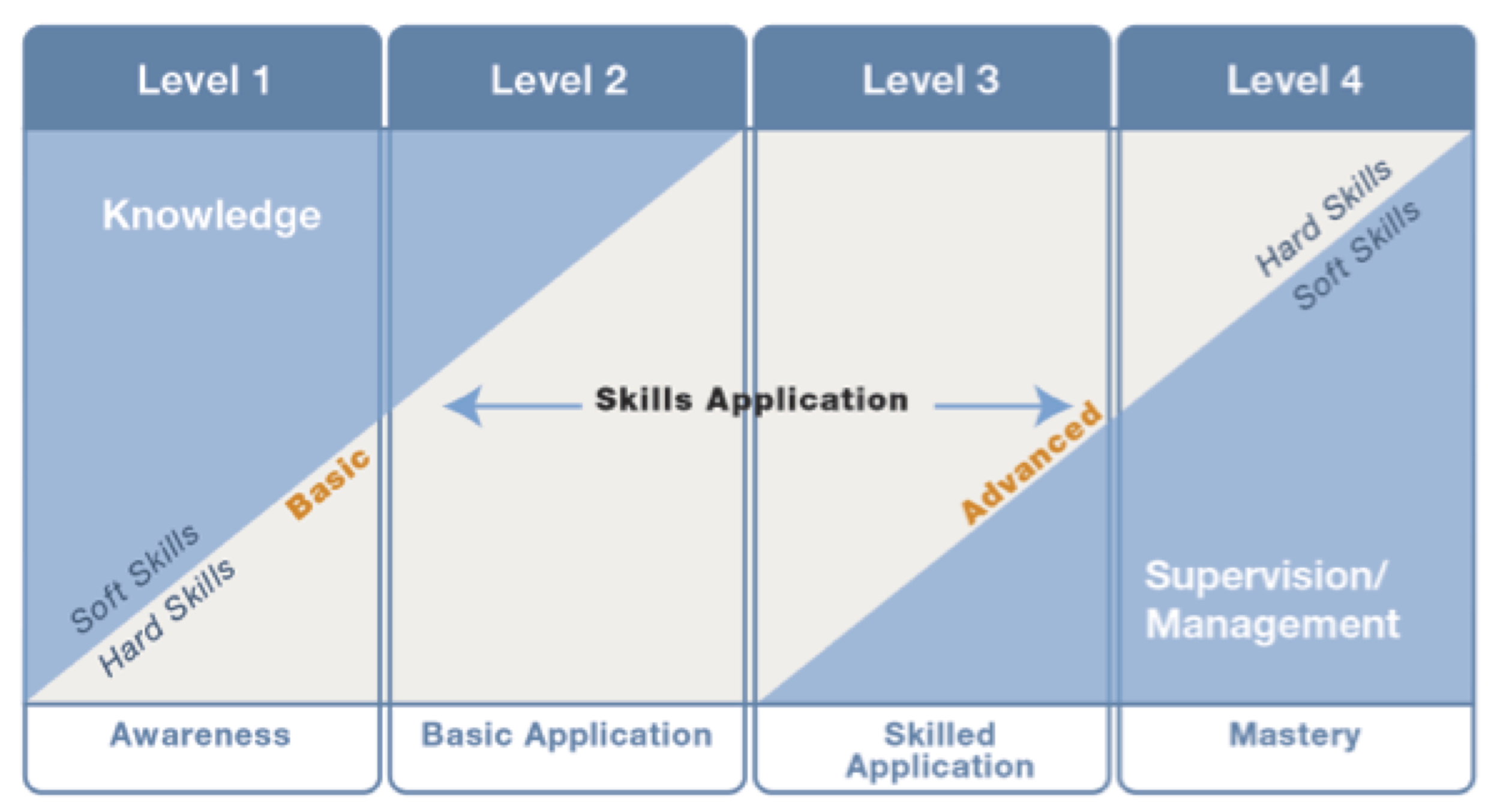
An indication of the expected level of performance of an employee in carrying out a specified task: Awareness (Level 1), Basic Application (Level 2), Skilled Application (Level 3) and Mastery (Level 4).

Job Rotation

Teaches current employees how to do various jobs over time. They rotate around to different jobs within the organization, performing different tasks unrelated to their original job, exposing them to new knowledge, skills, and perspectives.

Job and Task Analysis

A document that identifies and describes the knowledge and skills that a worker needs to do a job correctly.

Job hazard analysis (JHA)

A systematic study that involves observing a job; identifying ergonomic risk factors present in various steps of the job; and evaluating the duration, frequency and magnitude of ergonomic risk factors to determine if an MSD hazard is present.

Joint

A joint is a break, or fracture, of natural origin in a layer or body of rock that lacks visible or measurable movement parallel to the surface, or plane, of the fracture.

Joint Operating Agreement (JOA)

An agreement governing the rights and obligations of co-owners (participating or working interest owners) in a field or undeveloped acreage, defining how costs and revenues are shared, who is the operator, the operator's responsibilities including marketing production and accounting for costs, and the options available to other parties to replace the operator.

Joint Set

A joint set is a family of parallel, approximately evenly spaced joints that can be identified through the mapping and analysis of their orientations, spacing, and physical properties.

Joint System

A joint system consists of two, or more, intersecting joint sets.

Joint Venture Agreement

The special purpose partnership agreement that is executed by two or more working interested owners in an exploration/development project.

Joule

The work required to move an electric charge of one coulomb through an electrical potential difference of one volt.

Journal Bearing

A cylindrical bearing that fits like a sleeve around the part of a pump shaft called the journal; allows sliding contact with the shaft to oppose radial thrust

Jump

A pattern of instability on a control chart in which data points suddenly change from randomly falling around the process centerline to falling around a higher or lower value. Also called "level change"

Junction

A junction is any point in a circuit where current may split. Different branches of a circuit are said to join at a junction.

Junction field effect transistor (JFET)

A type of FET. A JFET's gate material physically contacts the channel material, forming a P-N junction. The JFET's P-N junction must always be operated in reverse bias to prevent current flow across the P-N junction.

joints

A joint is a break, or fracture, of natural origin in a layer or body of that lacks visible or measurable movement parallel to the surface, or plane, of the fracture. Although joints can occur singly, they most frequently appear as joint sets and systems.