Key Benefits
- Provides an understanding of a systematic structured approach to evaluate, develop, and execute major capital petroleum industry projects.
- Participants will learn how to assess the economics of the proposed investment and ensure their resiliency when faced with uncertainties in markets, available technologies, and other project parameters.
- Addresses project organization and governance requirements to ensure quality decisions and special considerations with Joint Ventures.
- Engages the planning process associated with EPC (Engineering, Procurement, and Construction) of major capital projects and steps to ensure successful execution.
- Highlights the risk management process to continuously evaluate risks and proactively address mitigating steps through the project cycle. Monitoring and stewardship system to ensure full compliance with all legal and regulatory requirements.
- Provides framework to capture learnings and best practices from project development and execution for future projects.
Instructional Format
This intensive program has a lecture and workshop format. Lectures are taught by experienced industry specialists and the workshop is facilitated by a simulation model specialist.
Who Should Attend
This program is ideal for those individuals who seek an integrated understanding of the development and execution of international petroleum projects. This may include executives, project managers, project engineers, procurement specialists, contractors, planners, government personnel, technologists, project specialists, construction personnel, finance personnel, and other specialists or stakeholders who interface and work in areas related to the oil and gas industry wishing to learn about the management of international petroleum projects.
Program Location and Schedule
Daily sessions will start at 8:00 AM and run until 5:00 PM. Participants will receive further information on location and schedule upon registration.
Program Content
Overview of the Petroleum Industry, Oil and Gas Value Chain
Oil and gas value chain; market structures; exploration and production; gas processing; gas liquids; unconventional sources; refining and petrochemical industry fundamentals; worldwide oil and gas economics; major players; evolution of the integrated oil and gas business; strategic objectives of an enterprise; need for large capital investments.
Energy Project Economics and Measures of Performance, Capital Projects Financing
Financial models; approach to evaluate investment alternatives; project cash flow analysis; discounted cash flow and internal rate of returns; cost of capital and impact of debt financing; other measures of project performance and sensitivities to changes in key variables; project financing considerations.
Staged Approach to Capital Project Management Fundamentals and Processes
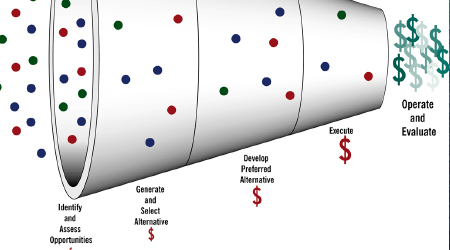
Application of the Stage Gate process to petroleum projects; introduction to case study used to illustrate the process through its five stages, as illustrated in the figure below.
Gas Supply and Market Opportunities, Pricing, Investment Alternative
Fundamentals of gas supply and markets, technology, economics, risk analysis and business fundamentals; gas production, gas fired power plants, ammonia / urea plants, small GTL plants, pipelines, gas processing plants; investment alternatives and tradeoffs, Joint Venture considerations.
Capital Project Fundamentals Commercial and Legal Aspects
LNG value chain, import and exports, gas reserves, developmental plans, project-related issues including commercial agreements, Sales and Purchase agreements, financing agreements, Joint Venture setup, term sheets.
Capital Project Fundamentals Technical and Execution Aspects
Project-related issues including project scope definition, facility planning, plant design basis, alternative technologies, licensor selection, project execution considerations including contractor selection.
Selection of Lead Investments Options, Joint Venture Considerations
Evaluation of alternatives based on strategic fit, criteria for comparison of options, investments, economics, uncertainties, risk mitigation steps. Special considerations for Joint Ventures.
FEL (Front End Loading), FEED, and Project Execution Strategies
Front end loading, basis of design, project execution plan, contracting strategies, FEED to EPC transition, EPC management options, cost and schedule development, safety assessment, project risk assessment, value improving practices, FID (Final Investment Decision) elements.
FID (Final Investment Decision) Development and Critical Requirements
Key elements of FID package, reconfirmation of business case, JV partner alignment, key commercial and legal agreements; financing agreements, technology selection, contracting strategy finalization, safety management, cost, schedule finalization, economic evaluation, sensitivity analysis, risk management.
Detailed Engineering and Procurement Strategies
Key activities during detailed engineering, procurement, coordination of offices and procurement centers, quality assurance and quality control, key success factors, stewardship of cost and schedule.
Safety Leadership and Management Systems to Achieve Flawless Construction
Critical role of safety leadership and a safety culture; safety management systems, safety pyramid, leading and lagging indicators in safety stewardship and incident prevention, incident evaluation, root cause analysis, proactive assessment of safety in the workplace, cultural diversity, and related challenges.
Construction Management during Execution
Execution issues during construction, safety during construction, contractor qualifications, subcontracting options, construction stewardship, organizational interfaces during construction, quality assurance and quality control, revamp vs. grassroots construction, best practices to manage diverse workforces and maximize productivity, precommissioning activities.
Safe and Flawless Startup and Commissioning
Key elements of startup, organizational design, safety during commissioning, pre-startup audits, training requirements, coordination with upstream, downstream facilities and customers, role of contractors and owners, development of punch-list items, handover to operations.
Project Closeout and Capture of Learnings, Project Reappraisal Post-Startup
Systematic approach to capture learnings from integrated project teams regarding facility design, safety, cost, schedule, quality assurance, EPC, as well as startup and commissioning aspects; project closeout documentation needs, reappraisal of investment post startup and comparison with FID basis.