
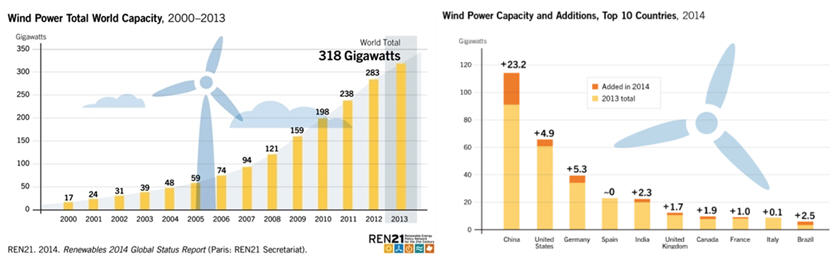
I still find it hard to believe. A friend of mine told me a year ago that he had just built a 350 MW solar farm in Nevada that is 2 miles by 3 miles in extent. I was even more surprised when he told me that the investment cost $1.5/watt, not the $6-10/watt that I was familiar with, that he would get his equity investment back in six months 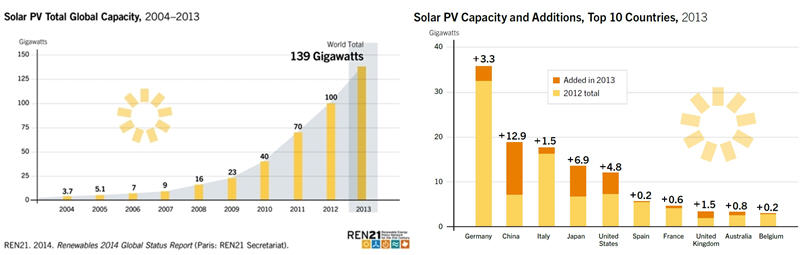 and be able to sell electricity at $0.06/kWh. The 1 million solar panels in Nevada produce electricity 27% of the time; not 14% that is the climate limit along the US East Coast.This year he told me that he was now investing in wind farms and had just finished building one in Nebraska which has 75 MW of capacity using 49 wind turbines on 5500 acres that provides power 52% of the time. He also said that, like solar panels, the cost of wind turbines has progressively declined. This investment, too, will return his equity investment in less than nine months. Collectively he is investing $1.5 billion per annum for his large utility parent and, of course, because the investment is returned so quickly he is under the gun to continue making the same investments each year. The investment climate is driven by state and federal governments that provide incentives to encourage forms of power that reduce greenhouse gases. The impact worldwide is impressive. In 2014, solar power grew worldwide by about 40 Gigawatts with the major growth taking place in China and the US. And wind power grew by 370 Gigawatts in 2014, almost 10x more than solar, with the largest growth, by far, taking place in China.
So long as government policies continue to provide investment incentives, my friend and many others like him worldwide will continue to invest in renewables. Natural gas, a less costly but environmentally attractive alternative, will continue to be the preferred “security of supply” power generation fuel. But if the capital cost of renewables continues to decline, the incentives may soon not be needed. This would further erode the demand for hydrocarbons, which is why Saudi Aramco reduced the cost of oil in 2014 – a concern that “peak demand” would occur sooner than expected and long before “peak supply.”